"1C", BAS, "UA-Budget", KBS - products of the occupier!
"The ‘1C’ of Discord. How a Russian business automation system took root in Ukraine" — under this headline, an article was published at the end of April this year on DOU.UA. We tried to highlight the key points of this material and add our own comments and clarifications as a company that has spent almost 30 years developing and implementing a Ukrainian program for automating accounting, financial and operational records.
The main message of the above-mentioned publication, like any other on a similar topic, is the idea of the "unsinkability" of the Russian product even after the occupation of Donbas, the annexation of Crimea, the imposition of 2017 sanctions, and the start of the full-scale military invasion of Ukraine on 24 February 2022. So how did this situation come about, and how do we get out of it?
The software products of the Russian company "1C" have historically been, since the early 2000s, among the most popular solutions for automating management and accounting at enterprises across the post-Soviet space, including in Ukraine. Even though this developer's products have been under sanctions since 2017, for several years right up until February 2022 Ukrainian companies maintained steady demand for "1C" specialists. And even now, job postings looking for accountants quite often include the line "experience working with 1C".
It is hard to accurately estimate the number of active companies using "1C" products in Ukraine, in particular because of the significant amount of pirated use of the software, but at the time the sanctions were imposed this figure reached as many as 500 thousand Ukrainian firms. Among them are state-owned enterprises that are directly prohibited from using "1C" software products and their derivatives, as well as state companies operating critical infrastructure in Ukraine. This was reported by the Security Service of Ukraine.
"Despite the [sanctions] measures taken by the state authorities of Ukraine, numerous cases are still being recorded of the use and deployment, at critical infrastructure facilities, of software developed or manufactured by business entities of the aggressor state (Russian Federation)", — according to an official letter from the Department for Counterintelligence Protection of State Interests in the field of information security at the SBU, signed by the head of the Department, Illia Vitiuk.
The SBU notes that the situation with state institutions using "1C" products poses a real threat to national security:
"The use by state institutions of software products subject to special economic and other restrictive measures (sanctions) creates a real threat of a breach of the confidentiality, integrity and availability of the data circulating in automated systems".
At the time sanctions were introduced against 1C in 2017, representatives of the Ukrainian authorities explained that such products could be used to collect information about user companies in order to undermine the country's economy.
How "BAS" became the successor to "1C" after the sanctions were imposed
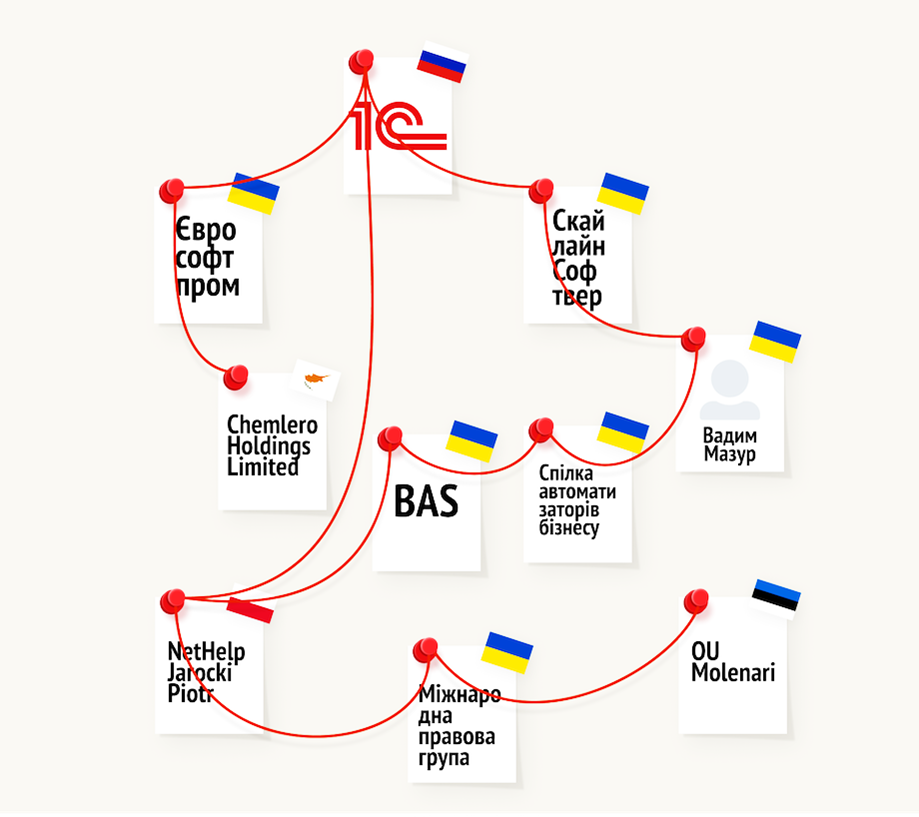
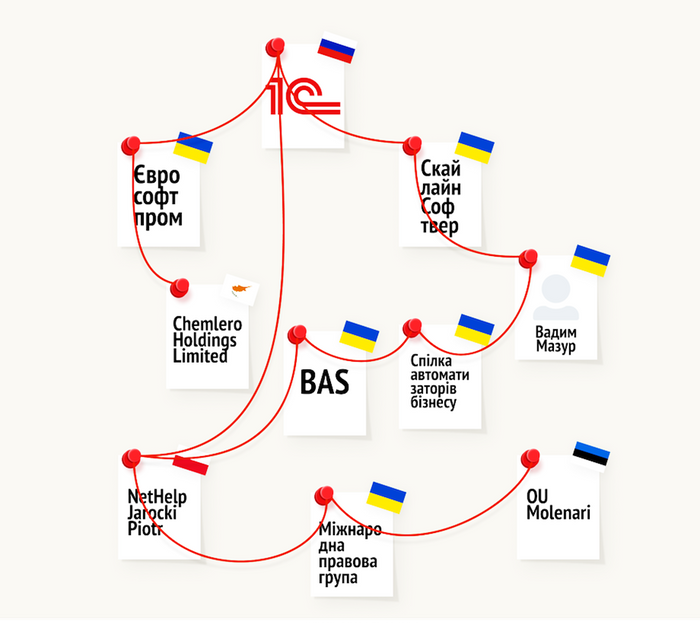
After sanctions were imposed on "1C" products in 2017, the successor to their technological solutions in Ukraine became the "BAS" system, which is supported by the Ukrainian "Business Automation Union". Its head is Ukrainian citizen Vadym Mazur, founder and director of the sanctioned company "Skyline Software", which acted as the supply operator for "1C: Enterprise" products under the auspices of "Eurosoftprom" until 2017.
Before russia's aggression began in Donbas and Crimea, it was "Eurosoftprom" — a subsidiary of a Russian firm that is also under NSDC sanctions, — that held the rights to the software products "1C:Enterprise" in Ukraine. However, in 2014 this firm was sold to the Cypriot company Chemlero Holdings Limited.
It was probably precisely after the actual sale of "1C" products in Ukraine became impossible due to the NSDC sanctions that Mazur and the "Business Automation Union" began promoting an analogue of these programs to Ukrainians — "BAS".
The owner of the "BAS ERP" trademark is the Polish company NetHelp Jarocki Piotr (Piotr Jarocki), located in the city of Zabrze. Public registers indicate that it was established in 2007 and has only one employee — presumably Piotr Jarocki himself. In Jarocki's LinkedIn profile, in the "Experience" section, it is stated that from 2008 to 2010 he was the lead developer at the Polish representative office of "1C", and the NetHelp Jarocki Piotr office in the Polish city of Zabrze, where the company is registered, looks like a private house in a photo from 2012.
It is known for a fact that the authorized representative of Jarocki's company in Ukraine, which represents his interests as the rights holder of the "BAS ERP" trademark, is the company "International Legal Group", which "helps users of business automation software". At the same time, the property rights to the "1C:Enterprise" program in Ukraine are held by the Estonian company OU Molenari, whose authorized representative is also "International Legal Group". You can draw your own conclusions.
Meanwhile, the ITS — the single agreement for getting access to the services and updates of business automation software, including "BAS" — is still concluded through the site on the subdomain 1c.ua. There is also a mirror of that site on the subdomain bas-soft.eu.
However, the sold Ukrainian "daughter" of the Russian firm now belongs to the Cypriot company Chemlero Holdings Limited — its director is Michailina Zinonis, whom unverified Russian sources call "the steward of the majority of Russia's assets, worth hundreds of billions of dollars", which may also be linked to the Russian businessman of Ukrainian-Jewish descent Viktor Vekselberg, who, in particular, is close to the Russian authorities and is under sanctions from the US.
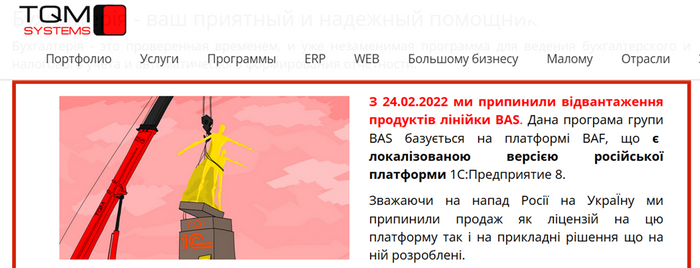
For example, on the website of TQM Systems, one of the suppliers of the aforementioned products, there is still a section for "1C:Enterprise", yet during 2021 clients were instead offered to purchase a license for "BAS" because "as of 01.01.2021 the program ‘1C:Enterprise Accounting’ has been discontinued". And only last month did a notice appear, referring to the date the war in Ukraine began, about abandoning Russian software. Is this yet another "repainting", or finally a manifestation of Ukrainian awareness? We very much hope it is the latter.
TQM Systems
Connection between "1C", BAS, "UA-Budget", KBS and the russian federation
Why Ukrainian companies are reluctant to give up Russian software
Reluctance to restructure established business processes, a license already paid for a certain period in advance, the high cost of switching to a new product — these are the main reasons why Ukrainian companies are not ready to give up the "1C", BAS, "UA-Budget", KBS systems.
Overall, all these reasons are nothing more than an excuse. Given the will, "1C" can be replaced with an analogue in minimal time, since Ukrainian business automation companies are ready to accommodate license purchases.
"Company employees are used to ‘1C’, and these changes may cause negative reactions on their part, but I think that conscious specialists will themselves become the initiators of such changes", — writes Ukrainian Software Engineer Oleksandr Lysyi, who for 11 years worked as a 1C programmer.
"Switching to a new system — is not just a financial expense (such systems can be very expensive) — the most decisive factor is the human one. The very willingness or unwillingness of staff to switch to a new system largely determines whether the project will be successful. In my practice there have been many cases where a system was built exactly to the company's requirements, but the staff kept inventing extra functionality without which, as they said, they would not be able to use the system", — says one of the consultants.
In most cases, employees of any company will have to adapt to the new accounting software, since the product needs to be "tailored" to the company's needs. And the time it takes to switch to a new system depends on the requirements of the firm itself regarding the processes it wants to automate. We have already written about how quickly such a transition can be carried out.
Recent attacks on 1C servers had their own "echo" for Ukrainian users of Russian software as well: the operation of some services was disrupted or completely halted. This once again confirms the connection with Russian companies.
The dealer network, which we wrote about in the piece "Dealer Network in the IT Industry: Innovation or Vestige?", is also currently responding actively to events surrounding the Russian product. More and more local specialists are considering switching to servicing other software, looking for ways to build new partnerships with Ukrainian companies. And those who have the opportunity are considering changing their line of business altogether. Might the companies that cling so tightly to Russian software soon find themselves alone with a program that is no longer updated and no longer developed?
So, for those who are waiting for a direct instruction "from above" to switch away from sanctioned (Russian) software, we can offer only one piece of advice: answer for yourself the question "Are you willing to quietly sponsor the enemy just because you've simply gotten used to your program's interface?". The argument in favor of switching away from Russian software lies primarily in the ethical realm. Ukraine is at war with russia. Because of products such as "1C", BAS, "UA-Budget", KBS, information about the companies that use them can be collected, and this information can then be used to undermine our country's economy. In addition, by buying a Russian product, you are financing the aggressor state.
This material was taken from the company Debet Plus. We are republishing it here to help spread this information further. The original is available at this link