

Java4Shell, SSHole and new PHP holes: what to patch in November 2026 🐚
Java4Shell, SSHole and new PHP holes: what to patch in November 2026 🐚
In October, everyone was busy patching PHP2Shell, a pair of PHP vulnerabilities instantly compared to the infamous Log4Shell. There was no time to catch a breath: the first three weeks of November brought Java4Shell in Java, 17 more security fixes in PHP, a password bypass in OpenSSH and a VMware vCenter zero-day that had been quietly exploited for two months.
Below we explain in plain language what happened, whether it affects you and what to do about it. No panic — but no “we’ll update later” either.
☕ Java4Shell (CVE-2026-114938): a critical vulnerability in Java
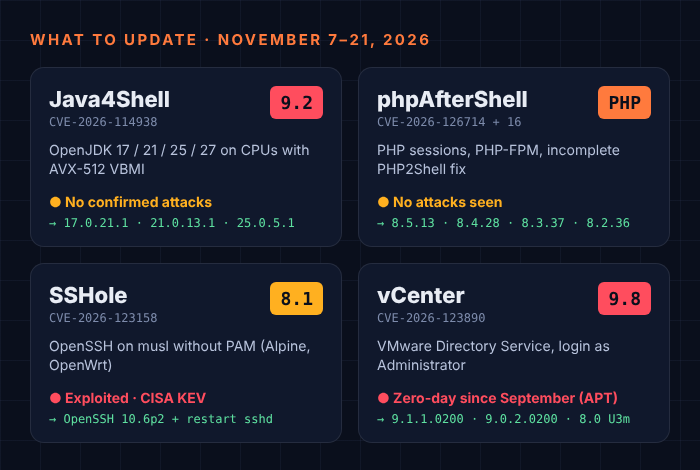
The bug was found by the research firm Calif — the same team that discovered PHP2Shell. The problem lives in the Base64 decoder of the Java virtual machine (HotSpot JVM): a specially malformed string can crash the application or let an attacker run their own code on the server without any login.
- Who is affected: OpenJDK and Oracle Java 17 (from 17.0.6), 21, 25 and 27. Java 8 and 11 are safe
- The key condition: the vulnerable code only runs on x86-64 processors with AVX-512 VBMI instructions. That means modern AMD EPYC (Zen 4 and newer) and recent Intel Xeon — exactly the servers companies have been buying for the last two years
- What’s at risk: according to The Hacker News, attacks are possible against Jira, Jenkins, Keycloak and other popular Java systems
- How serious: 9.2 out of 10 on CVSS v4.0. There are no mass attacks yet, but details leaked before the patch was released, and CISA recommends updating immediately
- How to fix: update Java to 17.0.21.1, 21.0.13.1, 25.0.5.1 or 27.0.1.1 (or your vendor’s latest build). If you can’t update right now, start the JVM with -XX:UseAVX=2
The tricky part: Java often lives inside Docker images, and a regular system package update doesn’t touch it. Updating the server isn’t enough — every container has to be checked.
🐘 phpAfterShell: PHP ships urgent fixes again
On November 19, PHP published 17 security advisories, seven of them critical. The loudest one was named phpAfterShell (CVE-2026-126714) and affects PHP’s default session mechanism.
- The bad news: one of the bugs (CVE-2026-129481) turned out to be a leftover of October’s PHP2Shell. So even those who dutifully updated in October are not safe yet
- The threat: remote code execution in certain configurations, including PHP-FPM — the most common setup with nginx
- Who is affected: practically any PHP website — WordPress, OpenCart, Laravel, Bitrix, online stores and CRMs
- How to fix: update PHP to 8.5.13, 8.4.28, 8.3.37 or 8.2.36 and make sure session.upload_progress.enabled=1 isn’t explicitly set anywhere in php.ini or your FPM configuration
If your website still runs on PHP 7.x or 8.0–8.1, there are no official fixes for those versions at all. That’s a solid reason to finally plan a migration.
🔑 SSHole in OpenSSH (CVE-2026-123158): logging in without a password
This one is already under attack. It affects OpenSSH on systems built with the musl library without PAM — the default configuration of Alpine Linux, as well as OpenWrt routers and embedded devices.
- How it works: a password longer than 256 characters lets an attacker into accounts where password login is disabled — including root and key-only accounts
- Scale: the first attack was spotted less than 9 hours after disclosure, and the vulnerability is listed in the CISA KEV catalog
- How to fix: update OpenSSH to 10.6p2 and be sure to restart sshd. Otherwise the old process keeps running with the hole open
🖥️ VMware vCenter (CVE-2026-123890): two months of hidden attacks
The most spy-thriller story of the month. According to Google Threat Intelligence, the China-linked group ARMORY CASTLE had been exploiting this vulnerability since September — long before the vendor knew about it.
- How it works: an authentication bypass that grants administrator access to vCenter. Score: 9.8 out of 10
- Why it’s dangerous: vCenter manages the entire virtual infrastructure, so access to it effectively means access to every server in the company
- How to fix: update to 9.1.1.0200, 9.0.2.0200 or 8.0 U3m (there is no workaround). Then check whether any new SSO administrators have appeared — the patch doesn’t remove what an attacker has already created
⚡ What else to update this month
- Microsoft: November Patch Tuesday fixed over 1,000 vulnerabilities, including an actively exploited Outlook bug (NTLM hash theft) and a critical Exchange vulnerability that can be triggered by a single email with an attachment
- Fortinet: 89 security advisories, including critical ones for FortiOS. No attacks yet, but a perimeter FortiGate is the first thing attackers probe once details go public
- N-able N-central: the 4EverAble2Shell chain is already being used to install cryptominers — even on servers with the latest update
- QNAP and Plex: NAS devices breached via Plex2Shell. The fix: update Plex Media Server to 1.43.3.10861 and close port 32400 to the outside world
- Apache Axis and Roller: two vulnerabilities scored 9.8, both already under attack
🧭 Where to start: a short action plan
1. Make an inventory of what you actually run: PHP, Java and OpenSSH versions, hypervisors and network gear. Most often the problem isn’t the patch — it’s the server “everyone forgot about”
2. Update internet-facing services first: websites, VPNs, mail servers, control panels
3. Don’t forget containers and embedded environments — Docker images, NAS boxes, routers
4. After updating, look for signs of compromise: new accounts, unfamiliar processes, suspicious files. A patch closes the door, but it doesn’t kick out whoever is already inside
❓ FAQ
Does Java4Shell affect my server if I don’t develop in Java? Possibly. Jira, Confluence, Jenkins, Keycloak, Elasticsearch and many other systems run on Java. If you use any of them, check your Java version and CPU.
I updated PHP in October. Is that enough? No. The November releases fix new vulnerabilities and complete the October PHP2Shell fix, so you need to update again.
How can I quickly check whether my SSH is vulnerable? If your server isn’t running Alpine Linux or another musl-based system, SSHole doesn’t affect you. On Alpine, just update the openssh package and restart sshd.
🛡️ Not sure everything is covered?
Manually checking a dozen servers, containers and network devices takes a day or two, and there’s always a risk of missing something. The Clapkey team runs infrastructure security audits: we find vulnerable PHP, Java and OpenSSH versions, update them without business downtime and check whether attackers left any “surprises” behind. Get in touch — we’ll help you figure out which items on this list actually apply to you.
Looks like “Shell” has become the most popular suffix of the year. Waiting for Excel4Shell 😅